
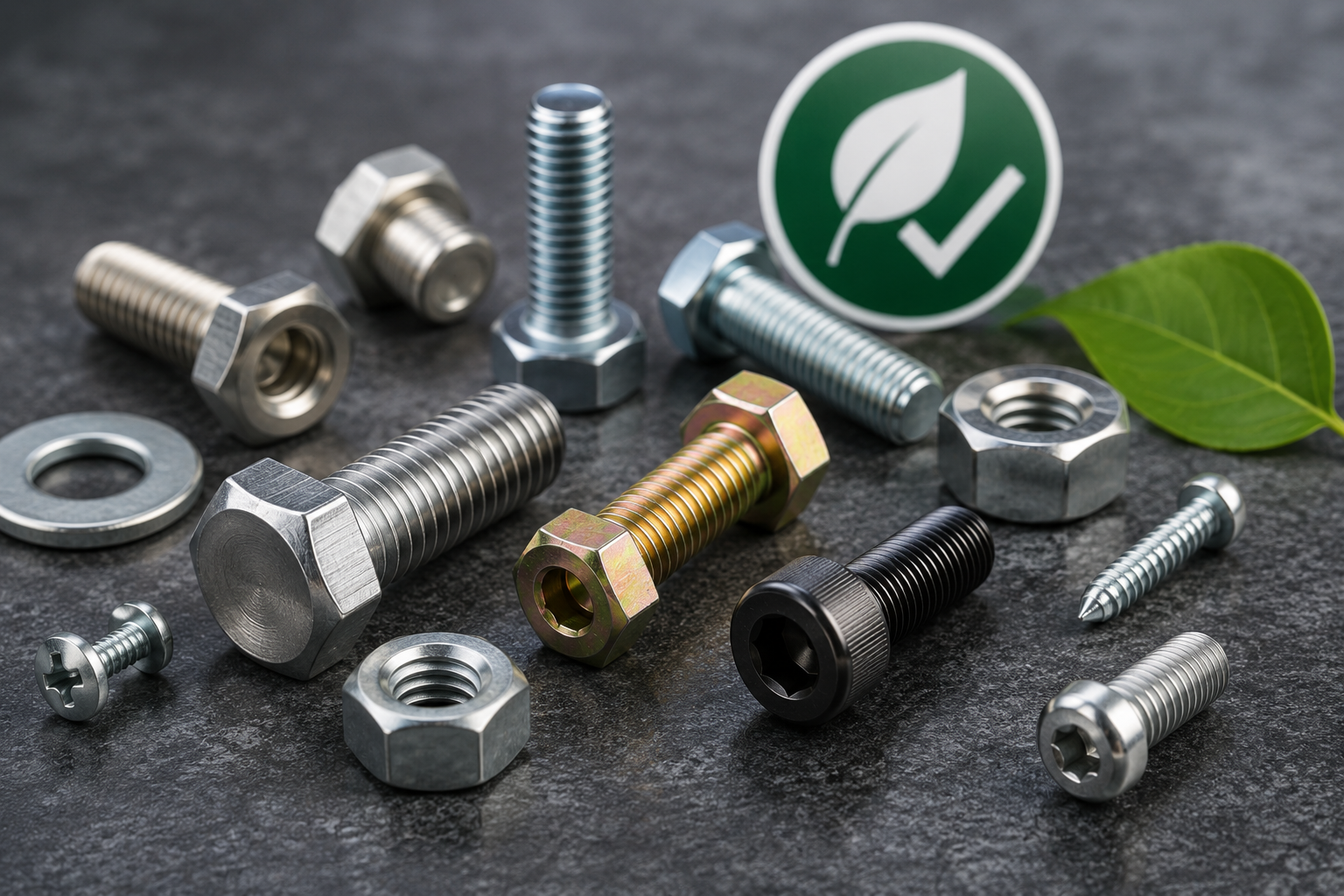
If you're selling products into the European Union, manufacturing electronics, or working with medical devices, you've likely encountered RoHS requirements. But what does RoHS actually mean for fasteners, and how do you ensure compliance?
This guide explains RoHS and REACH compliance in practical terms for fastener buyers.
What Is RoHS?
RoHS stands for "Restriction of Hazardous Substances" — an EU directive that restricts the use of certain dangerous materials in electrical and electronic equipment. It went into effect in 2006 (RoHS 1) and was updated in 2011 (RoHS 2) and 2015 (RoHS 3).
RoHS restricts these substances to specific maximum concentrations:
- Lead (Pb) — max 0.1% by weight
- Mercury (Hg) — max 0.1%
- Cadmium (Cd) — max 0.01%
- Hexavalent chromium (Cr⁶⁺) — max 0.1%
- Polybrominated biphenyls (PBB) — max 0.1%
- Polybrominated diphenyl ethers (PBDE) — max 0.1%
- Bis(2-Ethylhexyl) phthalate (DEHP) — max 0.1% (RoHS 3)
- Butyl benzyl phthalate (BBP) — max 0.1% (RoHS 3)
- Dibutyl phthalate (DBP) — max 0.1% (RoHS 3)
- Diisobutyl phthalate (DIBP) — max 0.1% (RoHS 3)
Why Does RoHS Matter for Fasteners?
The two restricted substances most relevant to fasteners are lead and hexavalent chromium:
Hexavalent chromium (Cr⁶⁺) was historically used in yellow zinc dichromate finishes — the iridescent gold finish you see on traditional Grade 8 fasteners. Cr⁶⁺ is a known carcinogen.
Lead can be present in some plating processes and as an alloying element. Most modern fasteners are lead-free, but lead-containing brass and some plating baths are still in use.
RoHS-Compliant Finishes
The finishes you'll commonly see on RoHS-compliant fasteners:
- Zinc CR+3 (Trivalent Chromium) — The most common modern replacement for hex-chrome zinc. Looks similar to old zinc yellow but uses safer trivalent chromium.
- Mechanical Zinc CR+3 — Mechanical plating with trivalent passivation.
- Black Oxide / Thermal Black Oxide — A controlled oxidation process. Uses no chromium at all.
- Hot Dipped Galvanized — Thick zinc coating, no chromium.
- Stainless Steel — Natural corrosion resistance, no plating needed.
- Cadmium-free — Cadmium plating is restricted by RoHS for general electronics use.
- Phosphate — Common on drywall and black-finish screws. RoHS compliant.
NON-Compliant Finishes (Avoid for RoHS Applications)
- Zinc Yellow CR+6 / Hexavalent — The traditional yellow zinc finish. Still produced for non-RoHS markets but must NOT be used for RoHS-compliant products.
- Cadmium plating — Restricted for most applications under RoHS, with very limited exemptions.
- Lead-containing solder or plating — No longer compliant.
How to Identify RoHS-Compliant Fasteners
When buying RoHS-compliant fasteners:
- Look for "Zinc CR+3" or "Trivalent Zinc" in the product description — this is the modern, RoHS-safe zinc finish.
- Avoid "Zinc Yellow CR+6" or unmarked "Yellow Zinc Dichromate" — these are likely hexavalent.
- Request a Material Declaration or Certificate of Compliance from your supplier for critical applications.
- Check for product tagging — at Ecom Fasteners, we tag every RoHS-compliant product so you can filter by it.
What About REACH?
REACH (Registration, Evaluation, Authorisation and Restriction of Chemicals) is the broader EU chemical safety regulation. It's much wider in scope than RoHS, covering virtually all chemicals used in commerce.
For fasteners, REACH compliance typically means: - No restricted substances above declared concentrations - Substances of Very High Concern (SVHC) declared if present above 0.1% - Material safety documentation available
Most RoHS-compliant fasteners are also REACH-compliant, but always verify with your supplier for critical applications.
US Regulations
While the US doesn't have a federal RoHS equivalent, several states have similar laws: - California Proposition 65 — Warning requirements for hazardous substances - California EWRA (E-Waste Recycling Act) — Restricts hazardous substances in electronics - Various state regulations on cadmium, lead, and mercury
If you ship to California, ensure your fasteners are RoHS-compliant to meet Prop 65 requirements.
When You Need Compliance Documentation
For B2B sales or regulated industries, you may need formal RoHS compliance documentation:
- Certificate of Conformity (CoC) — Manufacturer statement of RoHS compliance
- Material Declaration — Detailed substance composition
- Test Reports — Third-party verification (XRF spectroscopy is common)
Most fastener manufacturers can provide CoC documentation on request. For test reports, factor in additional cost and lead time.
Browse our RoHS-compliant fasteners → — every product tagged "RoHS Compliant" meets all RoHS 3 substance restrictions.