
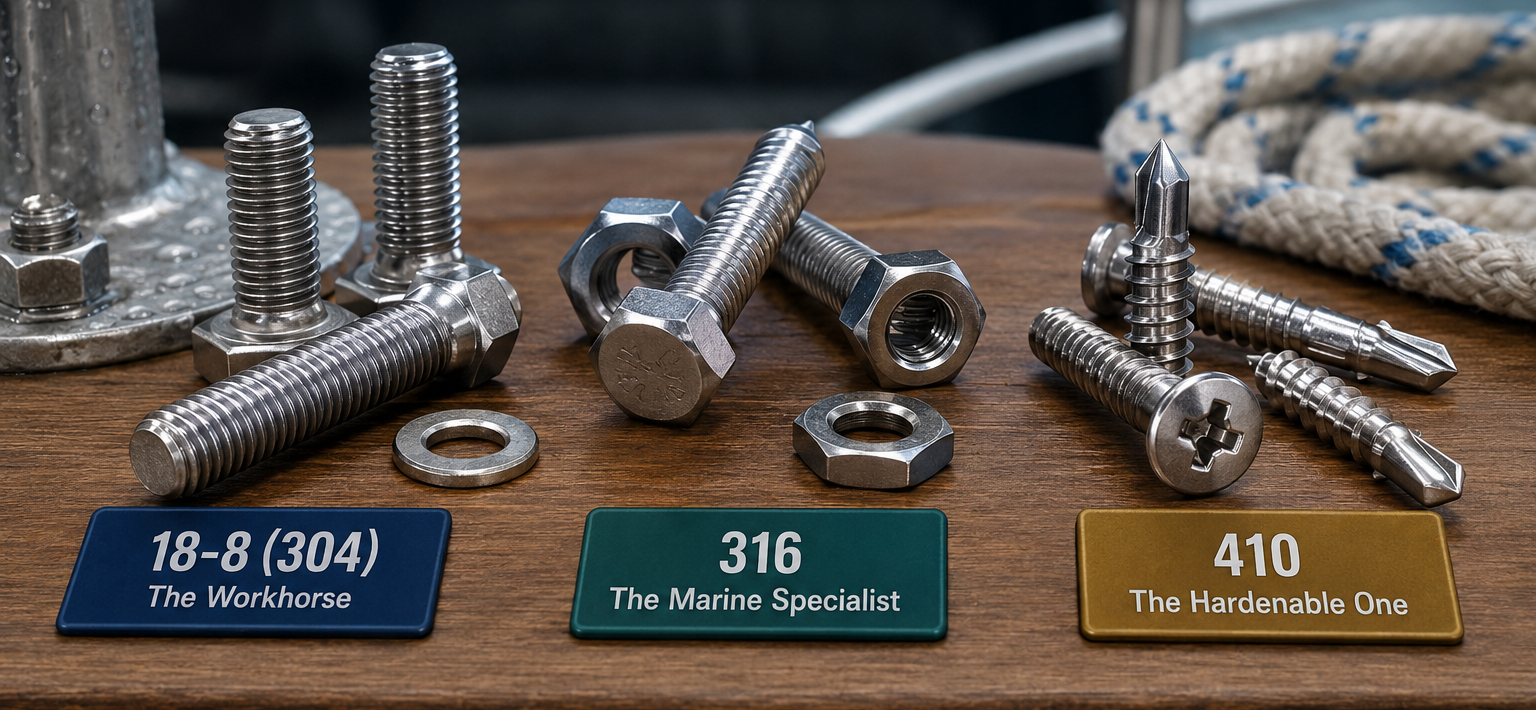
Stainless steel is the go-to choice when corrosion resistance matters, but not all stainless is created equal. The three main grades you'll encounter — 18-8 (304), 316, and 410 — have very different properties and costs. Choosing the wrong one means premature failure (or paying for performance you don't need).
This guide explains the practical differences between stainless grades and how to choose for your application.
The Stainless Steel Family Tree
Stainless steel is iron with at least 10.5% chromium added. The chromium forms an invisible protective layer (called "passive film") that prevents rust.
Different stainless alloys add other elements:
- Nickel (Ni) — Improves corrosion resistance and ductility
- Molybdenum (Mo) — Dramatically improves pitting/marine corrosion resistance
- Carbon (C) — Allows hardening but reduces corrosion resistance
18-8 (304) Stainless — The Workhorse
"18-8" refers to the composition: ~18% chromium, ~8% nickel. This is functionally equivalent to AISI 304 stainless steel.
Properties: - General-purpose corrosion resistance - Non-magnetic - Cannot be hardened by heat treatment - Tensile strength: 70-100 ksi (cold-worked higher) - Suitable for temperatures up to ~870°F
Use 18-8 for: - General industrial applications - Indoor commercial use - Kitchen and food prep (not heavy salt exposure) - Medical equipment (non-implantable) - Most outdoor applications away from saltwater
Don't use 18-8 for: Saltwater immersion, marine deck applications, swimming pool chemicals, chloride-rich environments. The chlorides will cause pitting corrosion.
316 Stainless — The Marine Specialist
316 stainless adds 2-3% molybdenum to the 18-8 composition. This small change dramatically improves corrosion resistance.
Properties: - Superior corrosion resistance vs 18-8 - Excellent saltwater performance - Slightly lower tensile strength than 18-8 - ~50-60% more expensive than 18-8 - Non-magnetic
Use 316 for: - Marine and boat applications - Swimming pools and spas - Coastal environments (within 5 miles of ocean) - Chemical processing equipment - Food and beverage processing (especially with salt or acids) - Medical implants (316L variant) - Pharmaceutical equipment
The extra cost of 316 over 18-8 is almost always worth it in corrosive environments — replacing failed fasteners or fighting rust later costs far more.
410 Stainless — The Hardenable One
410 is a martensitic stainless steel, meaning it can be heat-treated to high hardness — like regular carbon steel can. But this comes at a cost.
Properties: - Can be hardened to RC 40+ (hard enough to cut other steels) - LESS corrosion-resistant than 18-8 or 316 - Slightly magnetic - ~12-14% chromium, no nickel - Used where hardness is required
Use 410 for: - Self-drilling (TEK) screws — the hardened tip drills through steel - Self-tapping screws into hardened materials - Cutlery and surgical instruments - Springs requiring corrosion resistance + strength
Don't use 410 for: Marine environments, chemical exposure, or any application requiring the corrosion resistance of 18-8 or 316. The reduced chromium and lack of nickel make 410 only mildly corrosion-resistant.
Decision Matrix
| Application | Recommended Grade |
|---|---|
| Outdoor deck, fence, garden | 18-8 |
| Salt water dock, boat | 316 |
| Pool / spa hardware | 316 |
| Indoor industrial | 18-8 |
| Food processing (mild) | 18-8 |
| Food processing (acidic, salty) | 316 |
| Chemical exposure | 316 |
| Coastal (5 mi from ocean) | 316 |
| Self-drilling into steel | 410 |
| Medical (non-implant) | 18-8 |
| Medical implant | 316L |
Common Mistakes to Avoid
Mixing stainless with regular steel: Galvanic corrosion can occur when stainless contacts carbon steel in wet conditions. Use stainless on both sides of the connection.
Assuming all stainless is rust-proof: No stainless is truly rust-proof. Even 316 will eventually show surface staining in harsh marine environments — just much slower than 18-8.
Over-tightening: Stainless fasteners can gall (cold-weld) when tightened. Use anti-seize compound on threads and tighten to the appropriate torque specification (typically 70% of carbon steel values).
Assuming higher cost = always better: 316 is overkill for indoor industrial use. Pay for it where corrosion resistance matters.
Shop 18-8 stainless fasteners → | 316 stainless → | 410 stainless →