
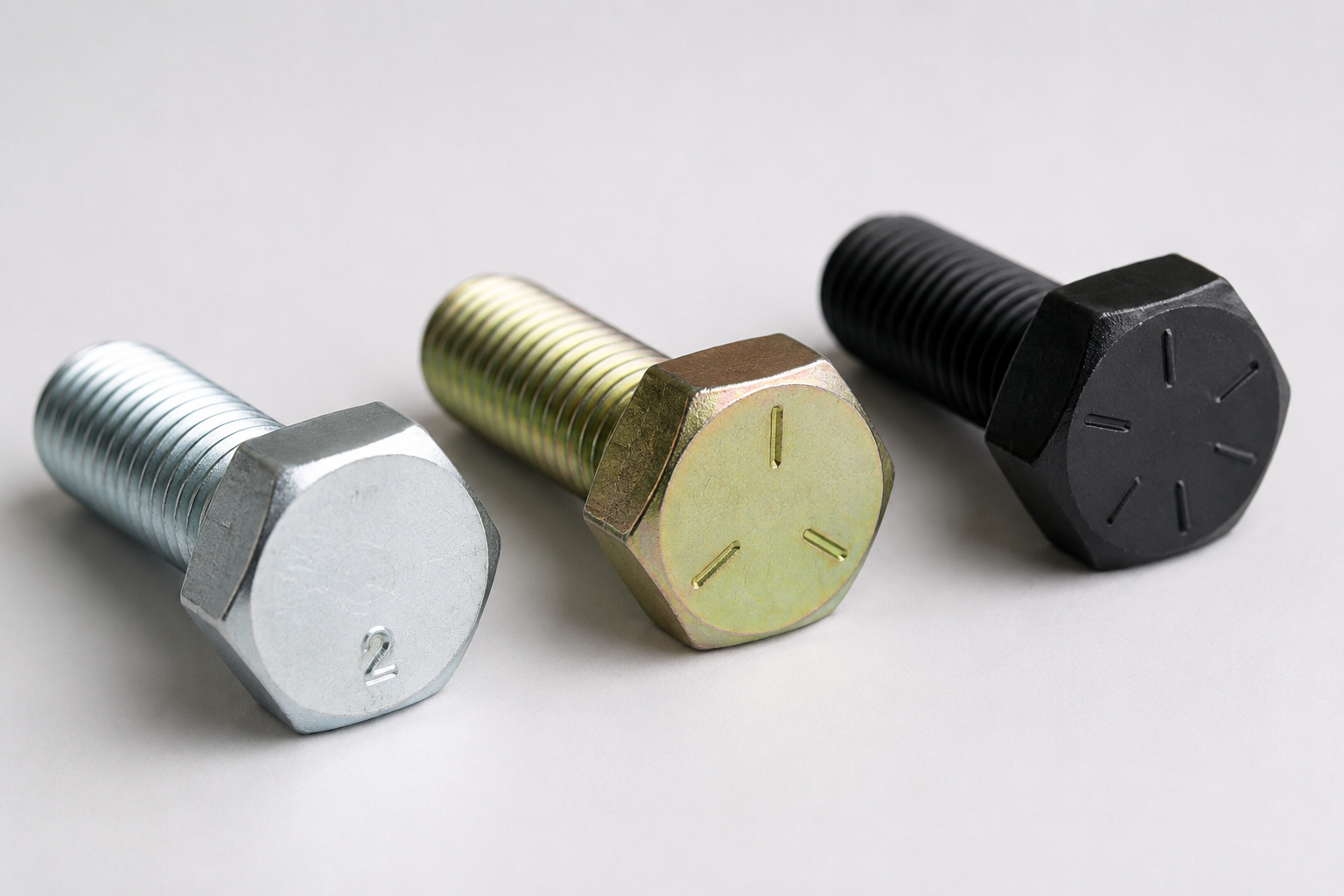
When you're buying a bolt or screw, the "grade" you choose determines whether your assembly survives the load — or fails catastrophically. But the grade system can be confusing: you'll see numbers like Grade 2, Grade 5, Grade 8, A325, A490, Class 8.8, Class 10.9, and Class 12.9. What do they all mean?
This guide breaks down the entire fastener grading system, what each grade is designed for, and how to identify it from the head markings.
What Is a Fastener Grade?
A fastener grade is a standardized classification of mechanical strength. It tells you three critical things:
- Tensile strength — How much force the fastener can take before breaking
- Yield strength — How much force it can take before deforming permanently
- Material composition — What it's made of (low carbon steel, medium carbon, alloy steel)
Choosing the right grade means matching these properties to your application's load requirements.
Inch Fastener Grades (SAE J429)
Inch fasteners (American standard) are classified per SAE J429. The three most common grades are:
Grade 2 — The Lightweight
- Tensile strength: 74,000 psi (74 ksi)
- Yield strength: 57 ksi (for sizes 1/4" to 3/4")
- Material: Low carbon steel
- Head markings: None (plain head)
- Common use: General assembly, light-duty applications, indoor projects
Grade 2 is the "default" fastener — what you'll find at the hardware store in bulk bins. It's inexpensive but not suitable for high-load or critical applications.
Grade 5 — The Industrial Workhorse
- Tensile strength: 120 ksi
- Yield strength: 92 ksi
- Material: Medium carbon steel, quenched and tempered
- Head markings: Three radial lines
- Common use: Automotive, machinery, general construction
Grade 5 is the most-used industrial fastener. About 60% higher strength than Grade 2, suitable for nearly all automotive and equipment applications.
Grade 8 — The Heavy Hitter
- Tensile strength: 150 ksi
- Yield strength: 130 ksi
- Material: Alloy steel (typically 4140 or 4037), quenched and tempered
- Head markings: Six radial lines
- Common use: Automotive suspension, off-road equipment, lifting, rigging
Grade 8 fasteners are 25% stronger than Grade 5 and 100% stronger than Grade 2. The traditional finish is yellow zinc dichromate for visual identification.
Specialty Grades
ASTM A325 (now F3125 Grade A325) — Same strength as Grade 5 (120 ksi) but designed for structural steel connections. Used in bridges and buildings.
ASTM A490 (now F3125 Grade A490) — Same strength as Grade 8 (150 ksi), designed for high-strength structural connections. Note: A490 should NOT be hot-dip galvanized due to hydrogen embrittlement risk.
L9 — A premium 180 ksi grade used in aerospace and racing.
Metric Fastener Classes (ISO 898-1)
Metric fasteners use a class number system that's even more informative than inch grades. The class is two numbers separated by a decimal — like "10.9":
- First number × 100 = tensile strength in MPa
- First number × second number × 10 = yield strength in MPa
For Class 10.9: tensile = 1,000 MPa, yield = 1,000 × 0.9 = 900 MPa.
Common Metric Classes
| Class | Tensile (MPa) | Yield (MPa) | Inch Equivalent |
|---|---|---|---|
| 4.6 | 400 | 240 | Grade 2 |
| 8.8 | 800 | 640 | Grade 5 |
| 10.9 | 1,040 | 940 | Grade 8 |
| 12.9 | 1,220 | 1,100 | Above Grade 8 |
Class 8.8 is the metric workhorse, equivalent to Grade 5. Class 12.9 is used in Socket Head Cap Screws, where the precision drive transmits high torque.
Stainless Steel Grades (ASTM F593)
Stainless steel fasteners use a different classification — based on alloy composition rather than mechanical properties:
- 18-8 / 304 stainless (Alloy Group 1-2): 18% chromium, 8% nickel. General-purpose corrosion resistance.
- 316 stainless (Alloy Group 3): Adds 2-3% molybdenum for superior marine and chemical resistance.
- 410 stainless (Alloy Group 4): Martensitic stainless that can be hardened. Used in self-drilling screws.
Stainless tensile strength varies by cold-working level — typically 100-125 ksi for fastener applications.
How to Choose the Right Grade
For light-duty indoor work: Grade 2 is fine and saves money.
For most industrial and automotive applications: Grade 5 (or Class 8.8) is the safe, cost-effective choice.
For high-strength critical applications (engine, suspension, lifting): Grade 8 (or Class 10.9).
For corrosion-critical environments: Choose stainless and accept the lower strength, or use Grade 5/8 with hot-dip galvanized finish.
For structural steel work: Use A325 or A490 with matching A563 Grade DH heavy hex nuts.
A Critical Safety Reminder
Always match the nut grade to the bolt grade. A Grade 5 bolt with a Grade 2 nut will strip the nut threads before the bolt yields — making the bolt's strength irrelevant.
For Grade 5 bolts: use Grade 5 (Class B) nuts or higher.
For Grade 8 bolts: use Grade 8 (Class C) nuts.
For A325/A490: use A563 Grade DH heavy hex nuts.
Browse our Grade 5 fasteners → | Grade 8 fasteners → | Stainless fasteners →