
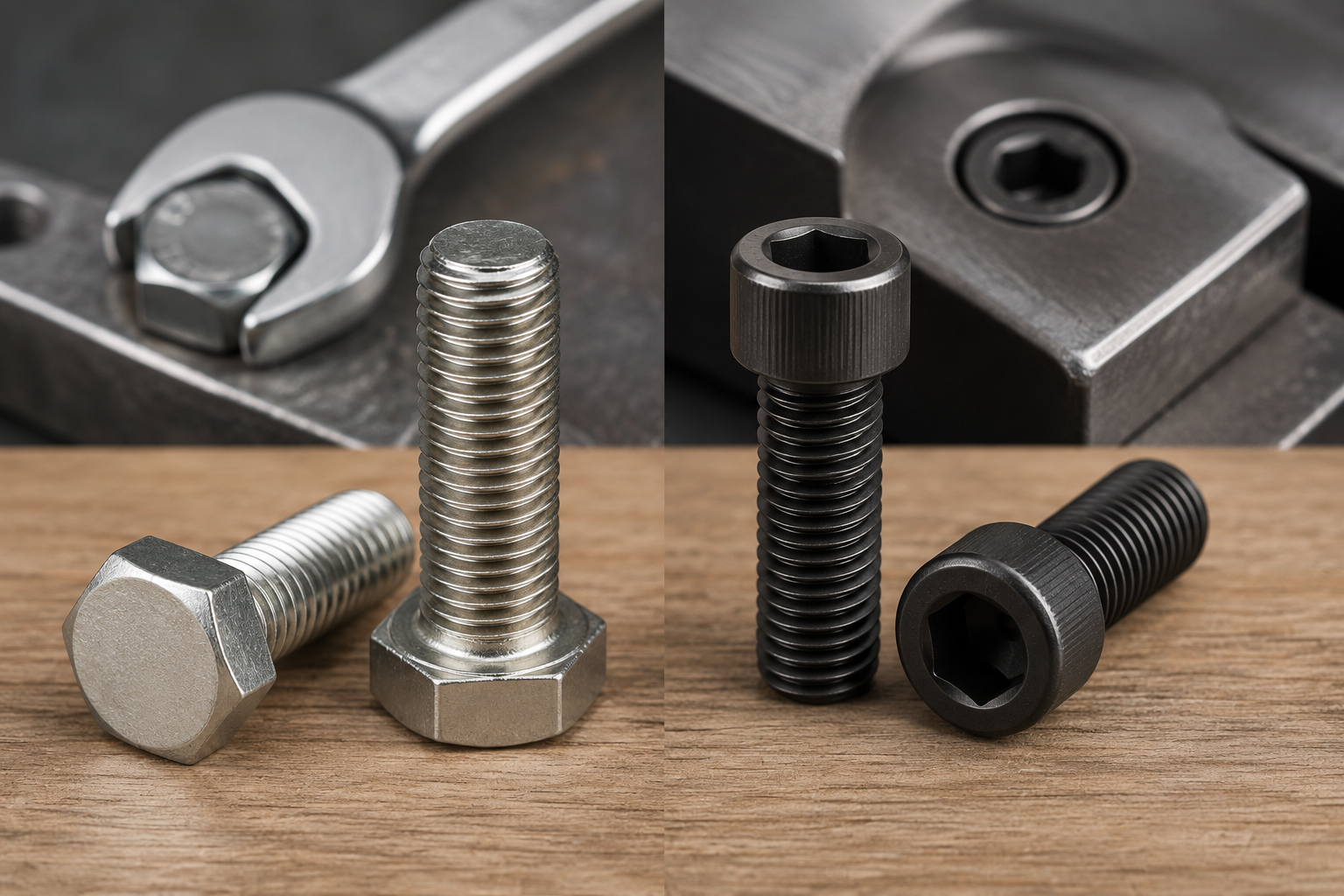
You need a heavy-duty threaded fastener. Should you use a Hex Cap Screw or a Socket Head Cap Screw? Both are strong, both are widely available, but they have very different characteristics and applications.
This guide compares Hex Cap Screws (HCS) and Socket Head Cap Screws (SHCS) so you can choose the right one for your project.
At a Glance
| Feature | Hex Cap Screw | Socket Head Cap Screw |
|---|---|---|
| Drive | External hex (wrench/socket) | Internal hex (Allen key) |
| Head shape | Hex (six-sided) | Cylindrical |
| Head height | Lower | Taller |
| Head width | Larger (across flats) | Smaller |
| Standard material | Carbon or alloy steel | Alloy steel (Class 12.9) |
| Standard finish | Zinc plated | Black Oxide |
| Standard | ASME B18.2.1 | ASME B18.3 |
| Typical strength | Grade 5 or 8 | Equivalent to Grade 8 |
| Cost | Lower | Higher (~30-50% more) |
How They're Different
Drive Mechanism
The biggest practical difference is the drive type:
- Hex Cap Screws use an external hex head — you turn them with a wrench, socket, or impact gun.
- Socket Head Cap Screws use an internal hex socket (Allen key drive) — you turn them with an Allen wrench or hex bit.
This affects tool access dramatically. SHCS work in tight spaces where you can't fit a wrench. HCS work where you can swing a tool.
Head Profile
Hex heads are wider but shorter: - A 1/2"-13 hex cap screw has a head 3/4" across flats and 5/16" tall. - A 1/2"-13 SHCS has a head 0.75" diameter and 0.50" tall.
The SHCS head sticks up more, but takes less side clearance. The hex head needs space for wrench engagement on all sides.
Material and Strength
Hex Cap Screws are available in multiple grades: - Grade 2 (74 ksi tensile) — light duty - Grade 5 (120 ksi) — standard industrial - Grade 8 (150 ksi) — high strength
Socket Head Cap Screws are almost always alloy steel, Class 12.9 / equivalent to Grade 8: - Tensile strength: 180 ksi (higher than even Grade 8!) - Yield strength: 162 ksi - This is because SHCS are precision-made for high-torque applications
So a Grade 8 hex cap screw and a standard SHCS are similar in strength. But a Grade 5 hex cap screw is significantly weaker than a SHCS.
Finish
- Hex Cap Screws come in any finish — zinc plated (most common), galvanized, stainless, etc.
- Socket Head Cap Screws are traditionally Thermal Black Oxide — a controlled oxidation process. Stainless SHCS are also available.
Black Oxide provides only mild corrosion resistance. For outdoor SHCS use, choose stainless steel.
Cost
Socket Head Cap Screws are typically 30-50% more expensive than equivalent Hex Cap Screws. This is because: - They're made of higher-grade alloy steel - Manufacturing requires more precision (the socket must be perfectly square) - Lower production volume
When to Use Hex Cap Screws
- Outdoor or wet environments — Choose Grade 5 or 8 with zinc plate or HDG, or use stainless.
- High-volume applications — Cost savings add up across thousands of fasteners.
- Where strength matters more than appearance — Hex heads are functional, not decorative.
- Structural connections — A325 or A490 heavy hex are the go-to structural fasteners.
- Powered installation — Air or electric impact tools work better with hex heads.
- Anywhere a wrench can reach — If you have tool access from the side, hex works great.
When to Use Socket Head Cap Screws
- Tight clearance / recessed installation — When you can't fit a wrench around the head, SHCS work in counterbored holes.
- Precision machine assembly — Class 12.9 strength + tighter tolerance is ideal for machine tools, jigs, fixtures.
- Aesthetic applications — The clean cylindrical head is more attractive than a hex head.
- High-torque requirements — The hex socket transfers more torque without slipping.
- Indoor industrial applications — Black Oxide finish is fine indoors.
- Automotive engines / hydraulics — The standard for engine block, transmission, and hydraulic assemblies.
- Aerospace and aviation — Where weight, precision, and strength are all critical.
Practical Examples
Choosing between options for these projects:
- Building a workbench: Hex Cap Screws Grade 5, zinc plated. Strong enough, easy to install with a wrench, low cost.
- Mounting equipment to a machine table: Socket Head Cap Screws. The recessed head sits flush in the counterbore, won't snag.
- Outdoor deck framing: Hex Cap Screws, hot-dip galvanized or stainless. Need corrosion resistance, can use a socket wrench.
- Assembling a CNC machine: Socket Head Cap Screws. Precision Class 12.9 strength, fits in counterbored holes.
- Bolting a generator to a concrete pad: Hex Cap Screws Grade 5 (zinc) or Grade 8 if higher strength needed. Use anchor bolts in concrete.
- Custom motorcycle build: Probably both. SHCS for engine assembly, hex cap for accessory mounting where appearance is less critical.
What About Other Options?
If neither HCS nor SHCS fits, consider:
- Button Head Cap Screws — Like SHCS but lower head profile (~75% the height). Hex socket drive.
- Flat Head Cap Screws — Countersunk head, sits flush. Hex socket drive.
- Hex Flange Bolts — Hex head + integrated washer flange. Faster installation, no separate washer needed.
- Carriage Bolts — Square neck under round head, prevents rotation in wood.